By Promod Puri
In one of his many profound spiritual moments, Guru Nanak Dev saw the cosmos not just as a marvel of creation but as a divine spectacle. With poetic brilliance, he expressed his gratitude to the Almighty for orchestrating this grand pageant of nature. His words formed what we now cherish as his Aarti—a devotional hymn of awe and enlightenment, celebrating the beauty and harmony of the universe.
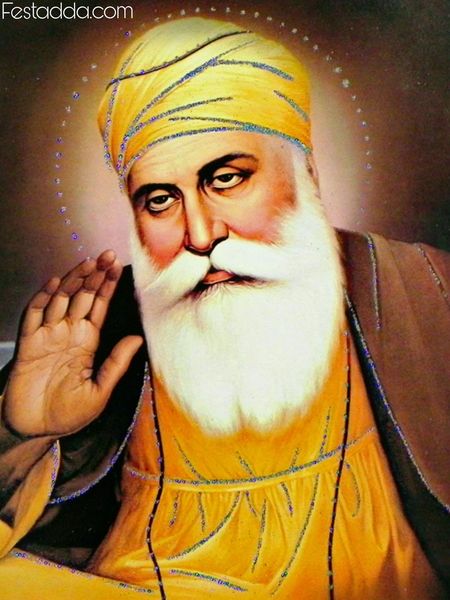
Aarti, in its traditional sense, is a ritual of light offering, derived from the Sanskrit word “aratika,” meaning the dispelling of darkness. But Guru Nanak’s Aarti transcended religious rituals. It was his soulful reflection on the entire cosmos performing an ongoing, universal act of reverence—a celestial worship service orchestrated by nature itself.

In Guru Nanak’s vision, nature’s elements come together in sync, offering their tribute in a grand cosmic concert:
Gagan Mai Thaal Rav Chand Deepak Baney, Tarika Mandal Janak Moti
Upon the cosmic plate of the sky, the sun and moon shine like lamps; the stars and constellations sparkle like pearls and jewels.
The Cosmic Symphony of Guru Nanak’s Aarti
Dhoop Malyanlo Pavan Chavro Kare, Sagal Banraye Phulant Jyoti
The fragrant breeze carries the scent of sandalwood like temple incense, and the wind moves gently, fanning the divine presence. All the earth’s flowers bloom as offerings on the altar of creation.
Kaisi Aarti Hoye Bhavkhandna Teri Aarti, Anhata Shabad Vaajant Bheri
O Lord, the dispeller of fear, what an extraordinary Aarti this is! The celestial vibrations resonate like temple drums, filling the universe with sacred sounds.
Guru Nanak’s Aarti reflects a spiritual philosophy far beyond rituals confined to temples or shrines. Here, the sky becomes the plate of offerings, the sun and moon are the lamps, and the fragrance of flowers wafts across the universe like divine incense. It is a hymn that turns the entire natural world into a place of worship, encouraging us to see spirituality everywhere—in the light of the stars, the breeze that brushes our skin, and the blossoming flowers underfoot.
Aarti as a Universal Prayer
The original Aarti by Guru Nanak was later enriched by contributions from saints such as Bhagat Ravi Dass, Sant Kabir, Sant Sain, Bhagat Dhanna, and culminated with Guru Gobind Singh’s additions.
However, the core spirit of Nanak’s Aarti remains universal: it reminds us that nature itself performs a continuous ceremony of reverence. The sun rises, the moon glows, stars twinkle, and flowers bloom—not just for one faith or tradition but for all of humanity.
Tagore’s Call for a Global Anthem
The profound beauty of Guru Nanak’s Aarti deeply resonated with Rabindranath Tagore, the Nobel laureate and visionary poet. Tagore believed this hymn of cosmic worship encapsulated the unity of existence and transcended religious boundaries. He suggested that Guru Nanak’s Aarti should be declared an international anthem for all humanity, symbolizing our collective participation in the divine rhythm of life.
Aarti for Today’s World
In an age where divisions are drawn along religious, cultural, and national lines, Guru Nanak’s Aarti offers a soothing reminder: we are all part of one vast, interconnected world. The same sun warms us, the same stars guide us, and the fragrance of flowers is a gift for all. Nanak’s Aarti invites us to embrace the spirituality embedded in the natural world and cherish the divine in the everyday beauty that surrounds us.
 Progressive Hindu Dialogue