by Promod Puri
At the very outset of the war against Iran by joint U.S. and Israeli forces, the world was shaken by the heartbreaking news of 165 schoolgirls killed.
It was not just a statistic; it was a moment of collective grief, a glimpse into the human cost of war.
For a brief time, outrage echoed across borders, condemning the violence that had taken so many innocent young lives.
Yet, as so often happens, that shock faded quickly.
Within days, headlines shifted back to strategy, geopolitics, and military developments.
The names, faces, and futures of those children disappeared from public consciousness, replaced by maps, strategies and commentaries.
————————————–
HUMAN TRAGEDY OF MODERN WARS
This is the unsettling rhythm of modern war: human tragedy briefly acknowledged, then quietly set aside.
In these conflicts, civilian lives seem to carry diminishing weight.
Their deaths are reported in numbers, not in stories. Their suffering becomes background noise to the louder narratives of drones, missiles and munitions.
———————————————————————–
THE THIRD PARTY
I call these civilian victims the “Third Party” in war, the silent majority caught between two opposing forces.
They are not combatants. They did not choose the battlefield. Yet they endure its worst consequences.
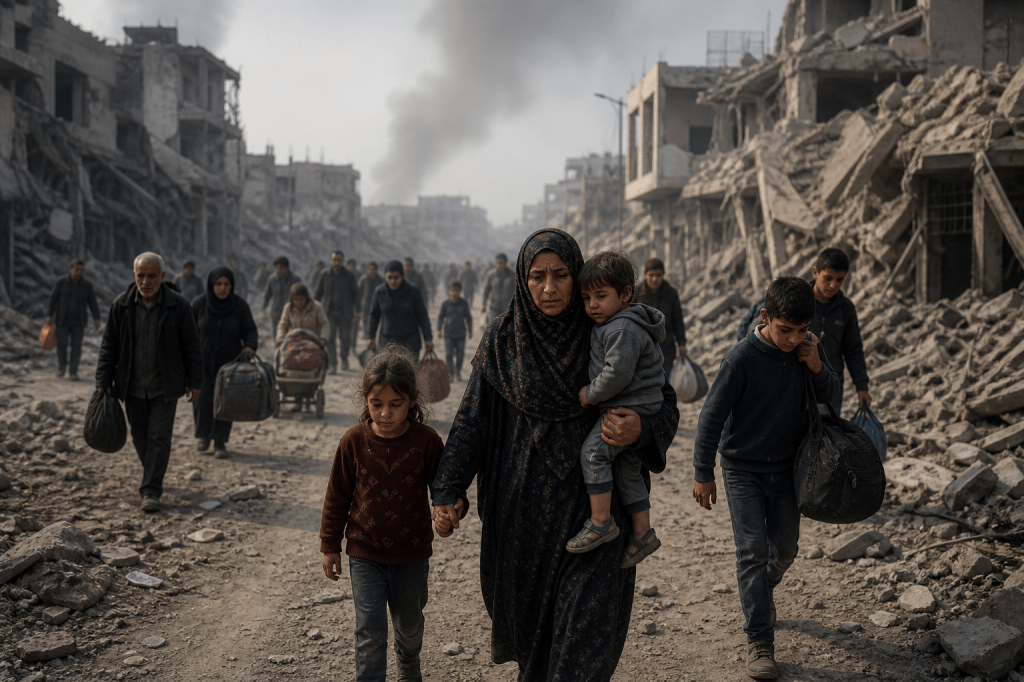
The Third Party extends beyond people; it includes the environment scarred by bombs. The birds, the animals displaced or killed, and ecosystems that may take decades to recover, if they recover at all.
Since the beginning of the U.S.-Israel confrontation with Iran, thousands of civilians have lost their lives across the region: in Iran, Lebanon, Israel, and the Gulf states.
As per the latest figures, 3375 citizens are dead in Iran, 2509 in Lebanon, 26 in Israel and 28 in the Gulf states. The death toll of civilians in other parts of the region runs into over 100.
————————————————————————–
OTHER CONFLICT ZONES
In another ongoing conflict, the war between Russia and Ukraine, beginning with the Russian invasion of Ukraine, has claimed the lives of 13883 civilians, as reported by the Office of the United Nations High Commissioner for Human Rights.
Beyond the dead are tens of thousands injured, many permanently, their lives altered in ways that cannot be measured by statistics, close to 59,000 alone in Ukraine.
Away from global headlines, other conflicts smoulder in places like Sudan and along the Afghanistan-Pakistan border, where hospitals, homes, and marketplaces become targets or collateral damage. In these quieter wars, the Third Party suffers just as deeply, though with far less attention.
———————————
MORE CIVILIANS DIE THAN COMBATING SOLDIERS
A stark truth emerges in modern warfare: more civilians die than soldiers who may be fighting with their remote devices far away from the battle zones and the bombed civilian dwellings.
The battle frontlines now extend into cities, schools, and homes. The distinction between combatant and bystander blurs, but the suffering does not.
Even when nations eventually lay down arms and restore diplomatic ties, the damage endured by ordinary people does not end.
Families remain shattered. Communities are displaced. Children grow up carrying trauma instead of memories of peace. The land itself bears scars that outlast political agreements.
———————————————————————-
SCARS OF WAR
War, for governments, can be concluded. For the Third Party, it rarely is.
And perhaps the most troubling reality is this: their suffering, though immense and enduring, seldom remains in the spotlight. It fades from news cycles, from political urgency, and too often, from collective memory.
Yet if we are to understand war honestly, we must keep the Third Party at the center of our attention, not as numbers, but as human lives whose value does not diminish with time or distance.
Nationalism, patriotism, heroism and even the so-called “defence” are irrelevant, insignificant and emotionless dogmas, beliefs and expressions when seen through the plight of the Third Party suffering the most, from generation to generation.
Photo generated by ChatGPT
 Progressive Hindu Dialogue